
Grafton Therapeutics is excited to share our newly published study in Frontiers in Oncology showing how our novel dual SSTR2/SSTR5 agonists are pushing the boundaries of what’s possible.
First-generation somatostatin receptor ligands (SRLs) primarily target SSTR2, but neuroendocrine tumors (NETs) frequently express multiple subtypes, including SSTR5. Grafton Therapeutics designed and synthesized five novel dual SSTR2/SSTR5 agonists (SMTR-001 to SMTR-005) to take a dual-receptor approach and enhance both anti-hormonal and anti-proliferative effects.
The new study confirms that our approach is very promising:
- Potent Anti-Secretory Activity: In human pancreatic NET models, our compounds significantly inhibited insulin secretion, often with greater inhibition than the standard treatment, octreotide. They also effectively reduced ACTH secretion in pituitary models.
- Strong Tumor Growth Inhibition: Each compound successfully reduced cell proliferation. Notably, when tested in advanced 3D spheroid cultures, our lead compound significantly decreased cell viability at all tested doses—an effect octreotide did not achieve under the same conditions.
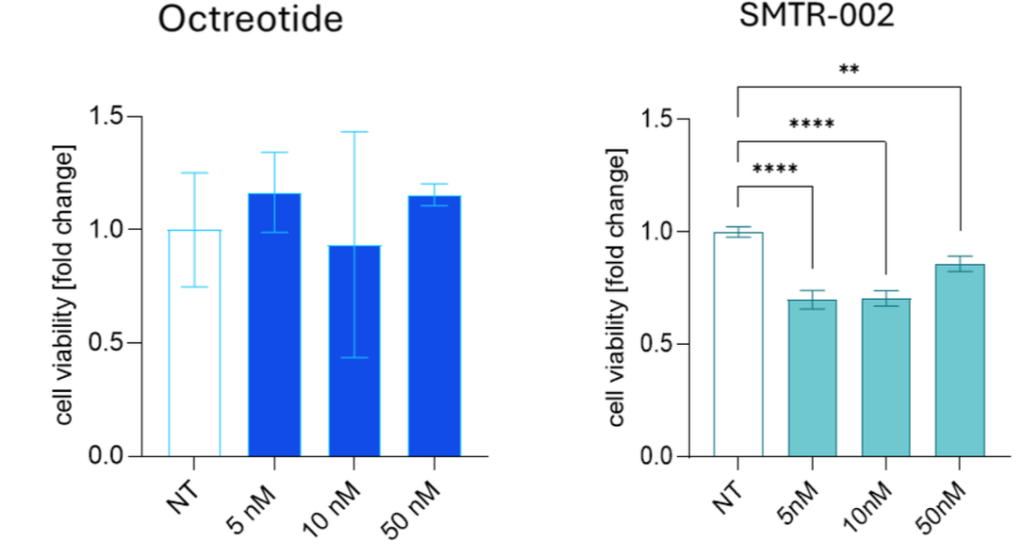
Dual SSTR2/SSTR5 agonists exhibit anti-secretory and anti-proliferative activity that is similar to, and often superior to, current reference SRLs in these models. These findings strongly support their further development as next-generation treatments for SSTR2/5-expressing tumors that are resistant to current therapies.
Grafton Therapeutics is now also developing these exciting compounds as radiopharmaceuticals for the diagnosis and treatment of resistant NETs and other cancers expressing SSTR2 and/or SSTR5.
A huge thank you to the brilliant research team of Prof. Natalia Pellegata at the University of Pavia (Department of Biology and Biotechnology “L. Spallanzani”) and all the authors for leading this incredible work!
Congratulations to co-first authors Francesco Fedeli and Margarita Bistika, as well as Francesco Ascione, Alessandro Marangelo, Fabio L. Guzzi, and Jörg Schrader.
